
Traveller-centric control
Article: Modernising long-distance traffic management: new IT for stable travel chains
DB Fernverkehr’s traffic management centres control day-to-day rail operations in real time. They decide which connections will be held and how staff and rolling stock will be deployed. This is precisely where the traveller-centric control system (RST) comes in. The existing legacy system is being transformed step by step into a modular product family that consistently aligns operational decisions with the travel chain and puts travellers at the centre.
Complex control of long-distance rail operations
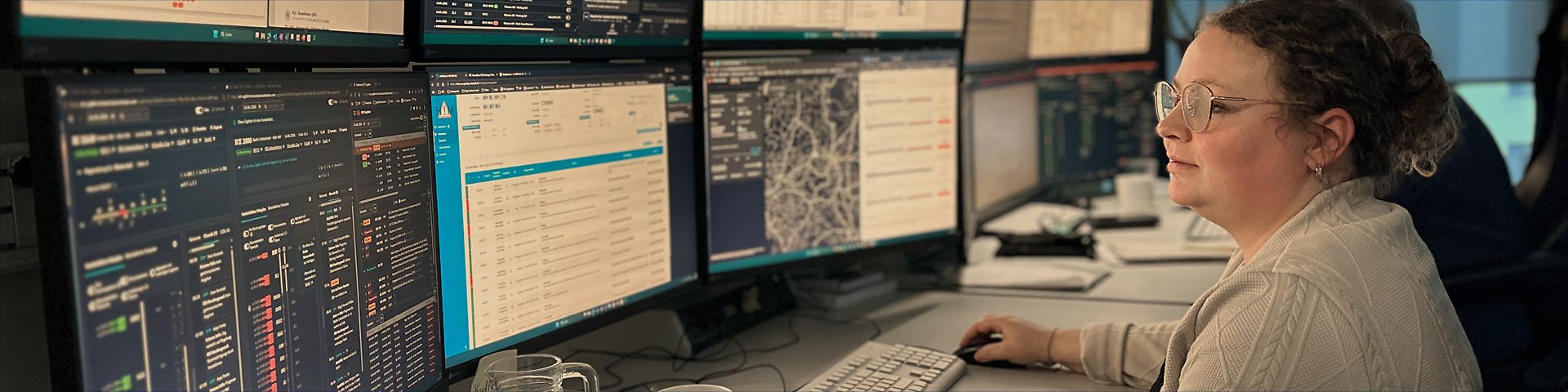
Around 400 employees at DB Fernverkehr work in shifts around the clock at seven traffic management centres across Germany. Working in traffic management is demanding. “Whenever a train cannot run as originally planned, or when a resource such as staff needs to be rescheduled, the traffic management centre steps in,” explains Julian Steinlein, functional project manager for RST at DB Fernverkehr. “Stops are added or cancelled, diversions are put in place, trains are cancelled. At the same time, rolling stock and staff have to be rescheduled.” All of this is done in close coordination with DB InfraGO, which is responsible for the infrastructure and safe train sequencing. The traffic management centres at DB Fernverkehr, on the other hand, are responsible for travellers, their connections and their destination.
Up to now, traffic management has used the “Transport Management Information System for Passenger Services” (ISTP) – an IT monolith that has evolved over time and has been operating reliably for around 25 years. “But the legacy system has now grown old and is difficult to further develop,” explains Jürgen Hallpap, IT project manager for RST at DB Fernverkehr. Adjustments were becoming increasingly time-consuming, modern views could only be integrated to a limited extent and involved a high level of coordination.
ISTP has strongly shaped the day-to-day work of dispatchers: parallel applications, fragmented views and a high proportion of manual monitoring demanded a great deal of attention. In demanding situations, this meant a lot of coordination across several systems. The call from traffic management for more support, better forecasting capability and a clear perspective on the impact on travellers grew ever louder.
From a train-centred to a traveller-centred view
At the same time, expectations on traffic management also changed: “We want to move away from a more train-centred view towards a traveller-centred view. The focus is on minimising final delay in the travel chain instead of pure punctuality,” says Jürgen Hallpap. In this context, travel chains refer to the sequence of partial services required to get from a starting point to a destination.
The response to these requirements is the traveller-centric control system. The new traffic management IT links the four core areas of disposition: traffic, rolling-stock and staff disposition, as well as traveller management. This creates, for the first time, a consistent picture of the overall situation. “Staff disposition did not play any role at all in ISTP,” explains Jürgen Hallpap.
The foundations of RST are a comprehensive real-time data base, analytical methods and artificial intelligence that recognises patterns and provides dispatchers with practical suggestions. An IT monolith is being replaced by a flexibly expandable, modular product family with an intuitive overall interface. This enables a quick overview and thus better decisions and consistent traveller information.
Today’s RST product family comprises eleven products that address different focal points of holistic traffic control. These include, for example, the “RST-Dia” product for connection disposition, which provides optimally prepared data for the best possible connection decisions and information. Or the “RST-BeRnd” partial product, which provides RST with a forecast of the traveller situation, forming the basis for traveller-centred decisions in disposition.
The greatest innovation is the shift from reactive to proactive control: RST can look into the near future to recognise and assess control requirements at an early stage, before they actually occur and before a dispatcher has to search for them manually.
“We take a holistic view of the system and make decisions where they have the greatest impact for travellers and operations.”

Continuous introduction instead of big bang
The introduction of RST is being implemented in three subprojects: the replacement of the existing ISTP system, the automation and optimisation of traffic disposition, and the introduction of staff disposition. A first milestone was reached in November 2025: technical pilot operations of the new solution began. Since then, the transition of the traffic disposition system from the legacy world to the new RST product family has been carried out step by step. “Over the course of 2026, we will phase out the legacy ISTP system for DB Fernverkehr,” says Jürgen Hallpap.
The rollout strategy for all products foresees that the first implemented use cases are made available at an early stage for voluntary use and testing in a friendly-user phase. Users themselves decide whether they want to work with ISTP or RST, and data consistency is ensured. Use in live operations provides valuable feedback on actual usability. “In addition, we regularly visit the traffic management centres on site, speak with users and managers, and obtain direct feedback there. There are also regular reviews as part of the development process,” reports Julian Steinlein.
One example of gradual introduction is traffic disposition with RST-V: from the go-live of the first use case (complete outage), voluntary parallel use with ISTP was already possible. In this way, user feedback could be incorporated into further development at a very early stage.
Other partial products, such as KoDi (delay coding) or RST-Dia (connection disposition), have already replaced all ISTP functionalities within their respective scopes and are in full productive use.
“Thanks to the partial-product strategy, we have been able to test individual products with different user groups for several years now. This allows us to respond flexibly and early to potential issues and to optimally prepare for the major milestone – the replacement of the legacy system.”

Partnership-based collaboration between DB Fernverkehr and DB Systel
DB Systel has been closely involved from the outset. “DB Systel also developed the previous ISTP legacy system and maintained and operated it for many years,” explains Wolfgang Harbach, Product Owner of the Smart Application Builder unit at DB Systel. With the restart, the architecture has been modernised and development placed on a shared application platform.
Collaboration between the two business units is organised along business processes with clear product responsibilities. Project management lies with DB Fernverkehr. Several autonomous, cross-functional DevOps teams develop and operate the new RST products. The teams comprise well over 100 employees from DB Fernverkehr and DB Systel. Within the teams, Product Owners from DB Fernverkehr steer product development, the architecture is developed jointly, and operations are the responsibility of DB Systel. Cross-team orchestration has been carried out using the Scaled Agile Framework (SAFe) since this year.
“We work together in a very partnership-based way, which I find highly value-adding. This is not a classic client–contractor relationship. Everyone is always committed to achieving the best outcome for the users of RST.”

From monitoring to active control
Feedback is particularly important because the way of working in traffic management will change with the new software. RST supports proactive control by dispatchers through data-based prioritisation and suggestions. In future, the system will provide support in day-to-day routine work, while dispatchers will make the demanding decisions in exceptional situations.
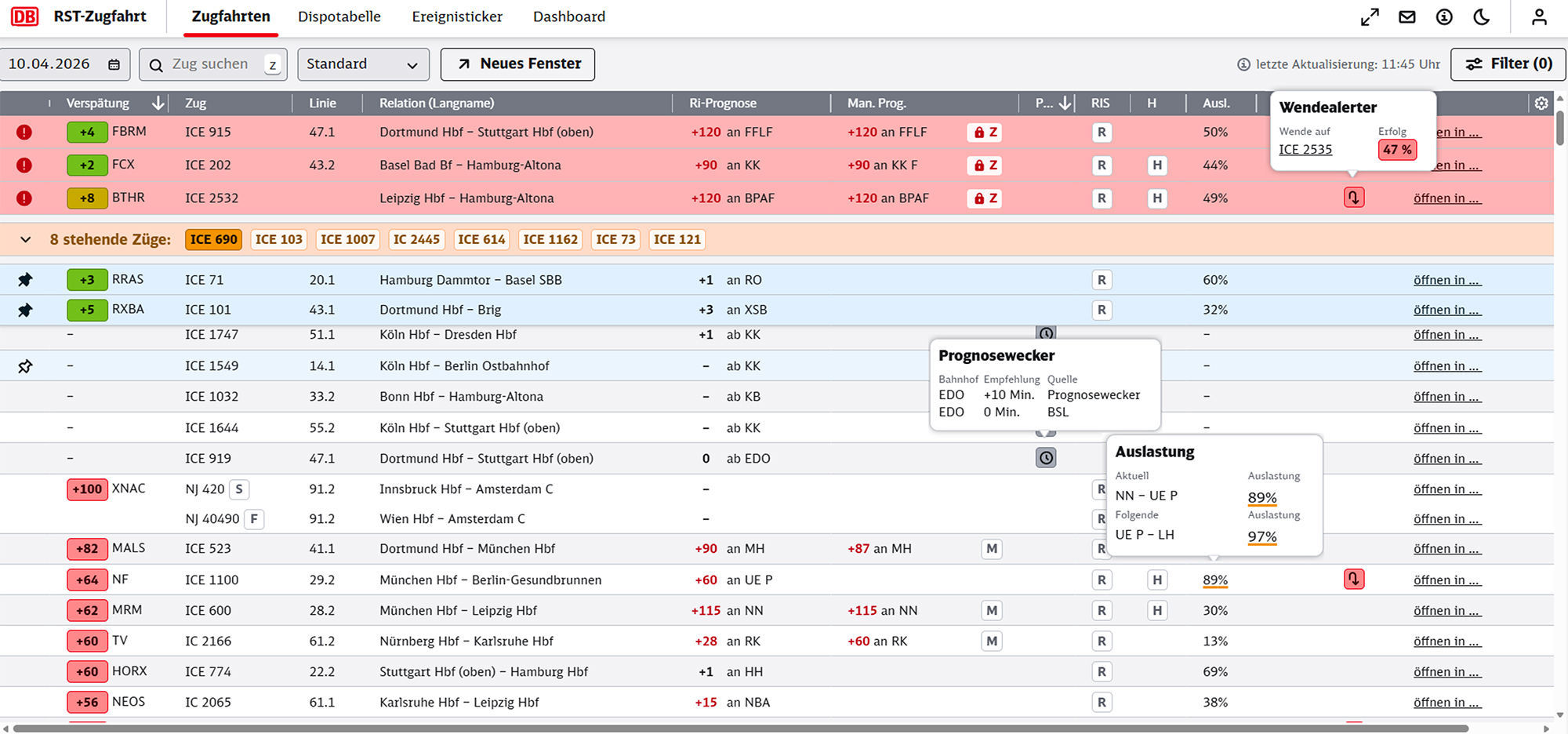
A central element is the consistent use of real-time data in RST. Analyses and forecasts support decision-making in the control centre. Artificial intelligence provides suggestions that stabilise operational conditions. Examples of this include AI-supported connection decisions that weigh up whether a connecting service should wait, or hints about turnarounds that are likely to be unfeasible. Another use case is the forecast alert. “This actively alerts dispatchers if manual forecasts are missing at any point and cannot be covered by the automatic forecast,” explains Jürgen Hallpap.
Continuous further development for better punctuality
The traveller-centric control system is the foundation for future-proof traffic management. It links previously separate disciplines, provides reliable forecasts and aligns decisions with their impact on travellers. Dispatchers manage exceptional situations and use systems that provide them with the best possible basis for doing so.
In the short term, the orderly decommissioning of the legacy ISTP system at DB Fernverkehr is the main focus. At the same time, the degree of automation and optimisation continues to grow. Over the next two years, the RST product family will be expanded further. Priorities include full utilisation of staff disposition and further development of forecasts and decision-support tools along the travel chain.
“Our goal is more stable operations for travellers and achieving our punctuality targets,” says Julian Steinlein. The business–IT fusion of DB Fernverkehr and DB Systel remains a key success factor. Close links to operations, continuous feedback and a clear product focus ensure that digitalisation has an impact where it is needed: in day-to-day deployment for travellers.

 Go
Go