

Mobility for all
Article: How digital support enables accessible travel
Rail is already the best mode of transport for many people with disabilities who want to travel independently. But there are still barriers at various points along the travel chain. With digital support, DB Systel and DB InfraGO are committed to removing as many of these remaining hurdles as possible. This can, for example, help blind people orient themselves at the station, or provide hands-on assistance with boarding and transfers for people with mobility impairments.
For travel to work for everyone in practice, numerous parties have to work together and many prerequisites have to be in place. That’s because different trains, complex travel chains, a branched railway infrastructure, and the interaction of people all come together here. A large part of the work to enable accessible travel therefore initially consists of listening to those affected and their representatives and looking at the specific circumstances on site. With practical trials and experimental technology, ideas and hypotheses are then put to the test.
In recent months, DB InfraGO and DB Systel carried out an extensive evaluation over many months to examine travelers’ needs, identify fields of action, and remove digital barriers. DB Systel’s “Solutions for Accessibility” team handles this foundational work as well as the design and implementation of ideas and solutions for accessible travel. “In surveys, travelers with visual impairments told us that they often do not embark on trips without a companion due to uncertainty,” recalls Marcus Sümnick, Product Owner of this team at DB Systel. “And that’s where we can make a huge difference.”
“What pleases me especially is that Deutsche Bahn is perceived as DB too. That we now live this internally and act hand in hand as DB, without stopping at business unit or organizational boundaries.”

Barriers are diverse
Accessibility has many facets. It starts with developing apps, websites, or other sources of information according to the principles of inclusive user experience (UX), so that they are, for example, machine-readable. Marcus Sümnick and his team research, test, and develop various digital offerings that can help people with impairments orient themselves at the station. The prerequisites vary greatly.
“There is a wide variety of impairments that affect people in their daily lives,” explains Anselm Reineke, who at DB InfraGO is responsible for services and service delivery at stations. These may include people with visual impairments or those who rely on aids such as a wheelchair. But travelers with hypersensitivity, sports injuries, or people traveling with several children also sometimes need support at the station. “That’s why you have to think of accessibility a bit more broadly,” says Anselm Reineke. The rising average age in society is also ensuring that more and more people encounter barriers in everyday life.
The platform hurdle
An important lever for reducing barriers and easing access is the physical, structural environment at the station, for example elevators for step-free access and guidance systems such as tactile guide strips for white cane users. Information on accessible entrances and whether all elevators are in service is digitally available for planning your journey: “That gives us an accessible station to begin with,” says Anselm Reineke. “Now the question is: how do people actually get onto the train?” explains the person responsible for station services. “In this interplay between infrastructure and train, barriers arise regularly.”
At the more than 5,400 stations of DB InfraGO, many different vehicle types operated by more than 100 rail companies nationwide serve local and long-distance services. Different boarding heights or doors on the trains therefore make boarding and changing trains more or less challenging for travelers with impairments. “This is a central barrier we want to bridge, and that’s what the mobility service is for,” explains Anselm Reineke. In practice, this mobility service means that station staff personally support travelers, for example when boarding and alighting or on the way to the train.
However, travelers must first register for this service, and staff coordinate it: “And this is where the central ‘Mobility for All’ project comes in to digitize the process and take it to the next level,” says Anselm Reineke. Under this umbrella, DB InfraGO and DB Systel are redesigning the coordination of assistance at stations from the ground up. The project is designed to run over several years: “We want to keep this barrier as low as possible so that people can travel as autonomously as possible - when they want and how they want,” says Anselm Reineke.
Finding needs-based solutions together
New structures at DB InfraGO, which is now set up as a public-interest-oriented company, and the experience of DB Systel’s accessibility experts make it possible to redesign the process and the technology behind it step by step to meet the requirements. In the past, the employees who handled registrations belonged to DB Vertrieb (Sales): “We have brought responsibility for the Mobility Service Center into infrastructure so we can offer it in a non-discriminatory way for the entire industry,” says Anselm Reineke. Station managers can now organize support centrally for all railway undertakings. A new interface also allows data exchange between DB InfraGO and all railway companies. This way, on-train staff also learn that, for example, a traveler in a wheelchair will board at a stop and can plan accordingly.
As a first step, DB InfraGO and DB Systel thoroughly analyzed the entire process from the travel request to the station. To build a comprehensive picture of the process, interviews were conducted with coordination staff, station employees, and staff from DB Fernverkehr, DB Regio, and partner railways. At various points in the travel chain, they are responsible for planning and delivering assistance. Combined with conversations with travelers and numerous site visits, the necessary requirements were worked out: “It was important that what we implement digitally matches analog reality. That we support these analog workflows and do not create digital parallel realities that don’t help,” says Marcus Sümnick.
Requesting assistance digitally
Most requests reach the center via a central contact form. Previously, this was in external hands; now DB InfraGO manages it itself and, together with DB Systel, completely redeveloped it as a first step: “We designed the registration form to be accessible and rebuilt it from scratch so we can continue developing it in an agile way,” says Anselm Reineke. Marcus Sümnick: “You can use the form to communicate very openly what kind of assistance you need.”
Depending on the answers, the form guides users through the process and asks appropriate questions. Central data sources in the background now ensure that users can no longer inadvertently provide ambiguous information, for example about the meeting point. The requests and orders must provide a reliable basis for station staff’s work in order to ensure a stable process for travelers; due to the uncertainties of railway operations, there are frequent short-notice changes in everyday life.
“We are still relatively analog here, which in a world where we have punctuality figures of 60 percent no longer works ideally.” If trips are delayed by the quirks of operations, change platforms, or run with a different vehicle type, “then the planning of mobility assistance from the previous day is practically no longer valid,” says Anselm Reineke. As a result, the carefully planned assignments for on-site staff change again and again at short notice. The next step is therefore to further digitize staff dispatching at the station itself to organize assignments more agilely.
“Now travelers can communicate their travel requests to us much more efficiently. We receive better data, which also makes it easier to process further or, in the future, to automate.”

Digital solutions for better orientation in the station
Navigation apps for people with visual impairments could be one way to give travelers orientation and relieve station staff. For example, in numerous real-world trials within a research project, DB Systel investigated how an app that uses text recognition can help people with visual impairments at the station: “We asked ourselves how we can give travelers more independence through orientation at the station while at the same time reducing the burden on staff.” One possible answer is artificial intelligence.
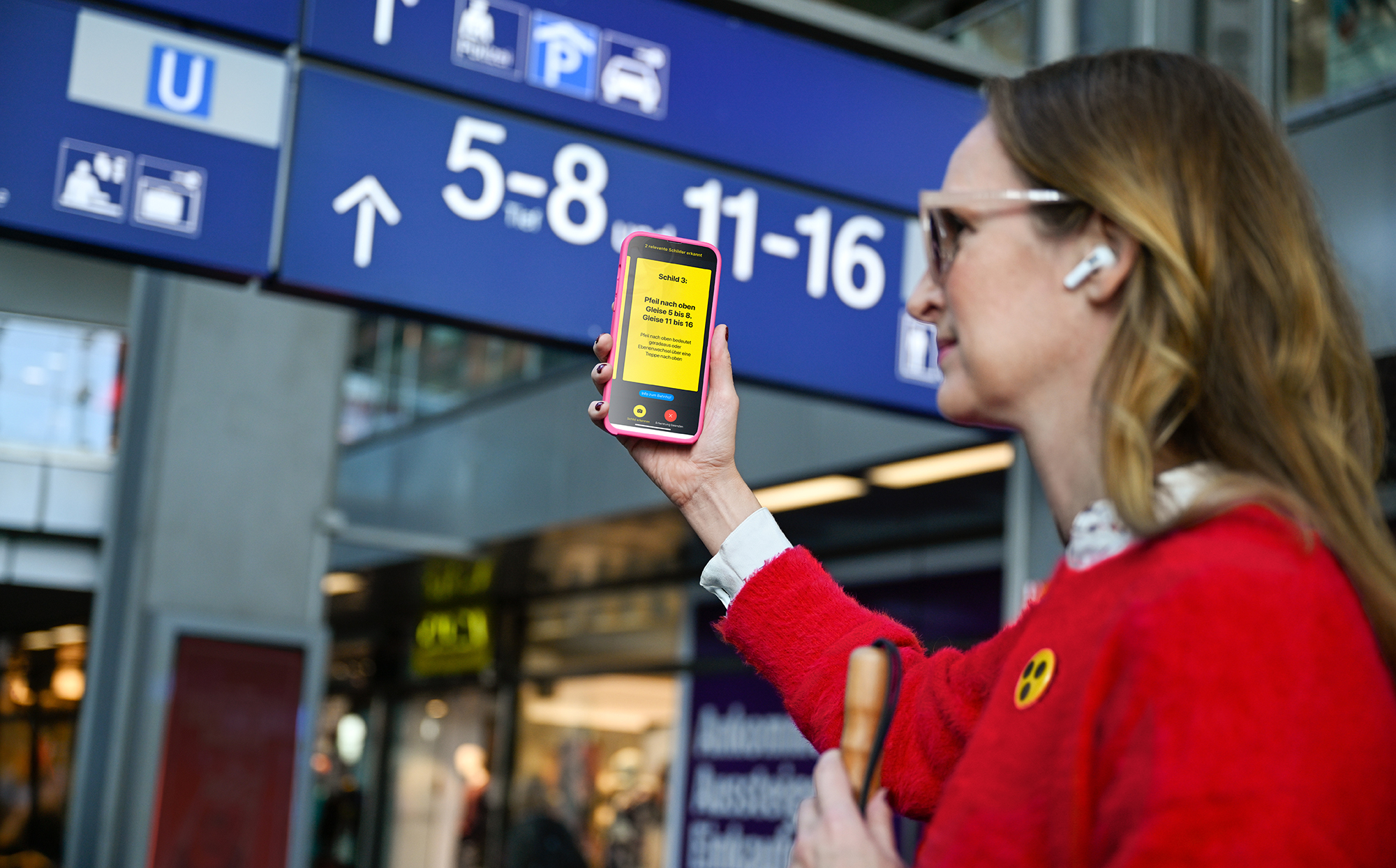
“The AI runs on the smartphone, looks at the surroundings through the phone’s camera, reads and understands the signs we have at the station, and helps answer orientation questions: How do I get to the locker? How do I get to the platform?” explains Marcus Sümnick. Additional sensors for indoor navigation complemented the technical trials. The results show that many people who are blind or have low vision are very good at orienting themselves confidently at their home stations. For many other situations and stations, digital support is perceived as a great added value. With DB Wegbegleitung, a pilot project has already successfully demonstrated how travelers can receive support with orientation at the station. In the future, these ideas could become practical solutions for travelers.
 Go
Go